


In today’s nonprofit landscape, relational fundraising is the name of the game. Donors expect the organizations they support to demonstrate that they’re integral community members working toward the same goal of furthering a good cause. Strategic outreach and personalization at scale are essential for your nonprofit to build the deep relationships necessary to secure donations—especially high-impact ones.
Relational fundraising begins with a thorough understanding of each current and potential donor, which your organization can gain through prospect research. While prospect research is most often associated with donor identification, it’s actually useful throughout the entire donor management lifecycle:
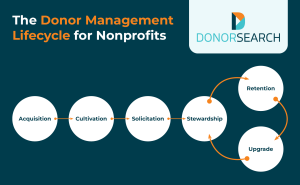
Let’s explore how to leverage prospect research at each stage of the donor journey to improve your supporter relationships and secure more high-impact contributions for your mission.
1. Acquisition
You’ve probably used prospect research for finding new donors already. However, your donor acquisition efforts will be most successful if your prospecting is thorough, strategic, and informative for team members who will conduct donor outreach (especially if they aren’t the same people as your prospect researchers).
Here are a few tips for improving your prospecting at the acquisition stage:
- Go beyond basic wealth screening. Just because a donor has the financial capacity to contribute a significant amount to your nonprofit doesn’t mean they’ll be willing to do so when you ask them to. Make sure to consider past charitable giving and indicators of an interest in your mission—i.e., philanthropic and affinity markers—alongside wealth data when identifying potential major donors.
- Prioritize your prospect lists. Even if you reveal capacity, philanthropic, and affinity markers for a prospect, there could be another potential donor who is a better fit for your needs or who is more likely to respond to outreach. Once you’ve found several good prospects, organize them based on the strength of each individual’s indicators and their propensity to give in the near future. (Pro tip: predictive AI tools are especially useful for speeding up data analysis and streamlining this prioritization!)
- Align donor affinity with fundraising needs. While every prospect should have a passion for your mission, some will be more inclined to contribute to certain programs and projects based on other interests, values, or aspects of their background. For example, a hospital might reach out to different donor groups for contributions to fund research in different departments (e.g., pediatrics vs. orthopedics) based on each donor’s giving, personal, and family history.
Create an individual profile in your donor database for each prospect you identify, and fill it in with all of the information you find at this stage. This way, you can easily refer back to your data as you continue cultivating donors.
2. Cultivation
The data you gather during the acquisition stage should continue to inform your interactions with donors after you’ve initially made contact with them. Cultivating a major donor can take weeks or even months, and throughout that whole process, you’ll need to align all communications with that supporter’s specific interests and past involvement to continue building a relationship that leads to a gift.
Some ways to ensure this alignment include:
- Using prospects’ preferred communication channels for meeting scheduling and follow-ups
- Sharing resources and impact data that align with individual philanthropic histories
- Putting donors in contact with staff and board members who share connections
- Suggesting non-donation involvement opportunities (e.g., events or volunteering) that match prospects’ interests and past nonprofit engagement
Paying attention to each prospect’s unique needs can help close the gap between what donors want to hear and your team’s communications with them, which sets you up for successful solicitations down the line.
3. Solicitation
Besides laying the groundwork during cultivation, research helps your team determine specific aspects of each donation request to ensure it lands appropriately. These elements include:
- Gift size, so you don’t risk leaving money on the table or offending a donor with an amount that’s too large for them
- Timing that considers prospects’ other charitable contributions, general financial situation, and the economy as a whole
- Format to make the ask land and give donors everything they need to make an informed decision about giving
Make sure to revisit your prospecting tools shortly before presenting a solicitation to check that nothing major has changed regarding that prospect’s finances or giving to other organizations, since those last-minute details can make or break your ask. Integrating your prospect research solution with your donor database is particularly useful here because a unified system allows you to conduct quicker, more frequent screenings.
4. Stewardship
Donor relationship-building shouldn’t end after a first gift—instead, it should set the stage for long-term involvement. Stewardship is the first step in maintaining engagement, and like the pre-giving relationship stages, it works best when it’s data-driven. Use what you’ve learned about each supporter through research and previous interactions with them to determine the best channels, timing, and messaging for strengthening relationships with each one.
To streamline this decision-making process, Meyer Partners recommends developing a stewardship matrix that lays out recognition cadences and responsibilities for different donor segments. Just don’t be afraid to go off script if a donor has a specific preference—it’s better to thank donors in an unconventional way that resonates with them than risk the relationship with generic methods that don’t consider their needs and wants.
5. Retention
A common ongoing challenge in the nonprofit sector is keeping supporters engaged in your work without coming across as overly promotional or demanding about their money. Many of the retention strategies that successfully overcome this challenge parallel the cultivation tactics you used previously—personalized communications, tailored non-donation engagement opportunities, and consistent-but-not-overwhelming outreach—all of which should be informed by research.
Additionally, as DonorSearch’s donor retention guide explains, your nonprofit needs to transparently demonstrate donors’ direct impact through statistics, images, and storytelling to secure their long-term support. Beyond recalling the programs and projects individual donors have supported, research can show you what impact reporting formats will resonate most with each donor and what specific data points would convince them to stay involved, based on how they’ve given and interacted with communications at your nonprofit and others in the past.
6. Upgrade
The upgrade stage of the donor lifecycle encompasses the systematic process of getting highly engaged current donors to give more over time. The results of these efforts can look like a supporter:
- Moving up a giving tier (e.g., mid-level donor to major donor)
- Donating more within the same giving tier (e.g., giving a $30,000 major gift when their last major gift was $25,000)
- Contributing on a more regular basis than before (e.g., annually rather than every few years)
- Taking advantage of a new, more valuable contribution opportunity (e.g., making a legacy gift or getting their donation matched for the first time by their employer)
Regularly screening your database can help you find donors who have the potential to upgrade, both in their wealth and in the dedication they’ve shown to your organization. Keep the same considerations in mind that you do at the solicitation stage—gift size, timing, and request format—when you present an upgrade opportunity.
Consistently using prospect research data across every stage of the donor journey leads to stronger, long-lasting support for your nonprofit’s mission. Remember to integrate your tools to make this application more efficient and keep your focus on your organization’s long-term success rather than honing in too much on securing a single gift.